




Where Mission Comes to Life: Catholic School Culture at Bishop Miege
At Miege, you can feel our mission in the way people know each other, show up for one another, and make room for everyone to belong. Our students and faculty had the chance to share that experience with guests from the ACE Principal Academy.
You don’t have to look far to find the Miege difference.
Catholic school culture at Bishop Miege is visible in a student who feels comfortable bringing a new idea to an administrator. It’s in a teacher who sees a student as a person first. It’s in seniors who know freshmen by name. It’s in the encouragement to try something new, find a passion, and discover where you belong.
Recently, Bishop Miege had the opportunity to welcome members of the ACE Principal Academy’s Cabrini Fellowship, a two-year professional formation experience for Catholic school principals. The visiting school leaders spent time at Miege observing practices that strengthen a shared language around excellence and help create a Christ-centered, intentional culture of joy.
We loved having the opportunity to share some of our own Mission Moments through a student and faculty panel, where our guests heard directly from the people who experience the Miege community every day.
And what they heard was simple: Miege is a community built on relationships.
Belonging is at the heart of Catholic school culture
For senior Joseph Jaksa, Spirit Committee President, that sense of belonging is part of what makes the Miege experience unique.
Joseph described the friendships he has built across grade levels as one of the clearest examples of what community means at Miege.
“We’re friends with all the grades, like we’re not strictly just friends with the seniors,” he said. “My buddies are juniors, sophomores, and freshmen, and I think that really means a lot. I think that’s actually what we think that community means here.”
That sense of connection starts early and continues throughout a student’s time at Miege. Through the Herd System, students are connected to Faith Families and Herds that bring together students from different grades, creating opportunities to know and support one another across the school.
Senior Isaac Frenzel experienced that sense of possibility when he shadowed at Miege. He came in wondering whether his experience would look like his older brother’s, only to discover that there wasn’t one prescribed path.
“As soon as I got here, I realized that there’s a million worlds within the one world at Miege,” he said. “It was amazing to see that it’s not just one path. The second I stepped in, I realized you’re not confined to what you want to do, but the reason people are so set on what they want to do by their senior year is because this school gives you confidence and helps you find that passion so deeply.”
For Isaac, Miege became a place where he could find his own path.
That belonging also comes with a responsibility to care for others. Senior Luci Switzer, a Bohaty Herd Executive, described the way students learn to carry that responsibility forward.
“I think we just go the extra step before we’re asked to, and just along with that reiterating to people especially in our Herds, ‘We’re here for you, but you also should be here for others,’ and just passing that down,” she said.
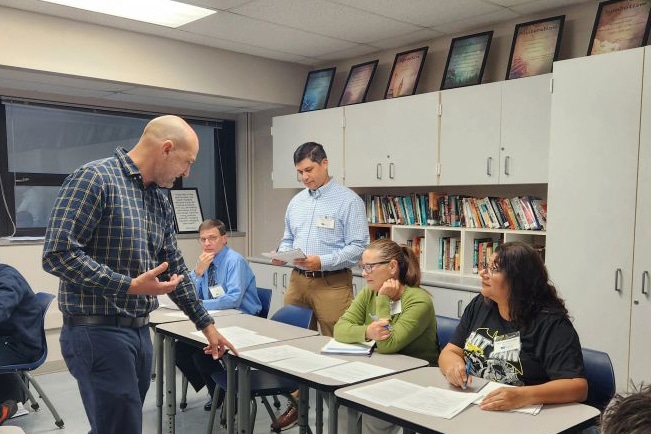
In English Department Chair Dan Fournier’s classroom, our guests got a look at learning in action and the relationships that make the Miege experience unique. Their visit also included a faculty and student panel, giving them the opportunity to hear directly from the people who live our mission every day.
Students have a voice in Catholic school culture
At Miege, belonging also means having a voice in the community.
Senior Elsie Kellerman, a Millie Herd Executive, shared how the Herd System gives students opportunities to bring ideas forward and see those ideas taken seriously.
“Through the Herd System, we get a lot of student voice involved,” she said. “I think we definitely have a lot of say in things. We can go to Mrs. Switzer or Dr. Keith and have a crazy idea, or have an idea that gets more people involved, and they’re 100% looking into it and wanting to come up with a plan to get it done.”
That same culture of openness allows students to try something new, pursue a passion, and discover where they fit. It gives them room to grow into the people they are becoming rather than expecting them to arrive with everything figured out.
For Isaac, that meant discovering that there were many different paths available to him. For Elsie, it means knowing that a new idea can become a plan. For students throughout the building, it means understanding that their experience matters and that they have a role in shaping the community around them.
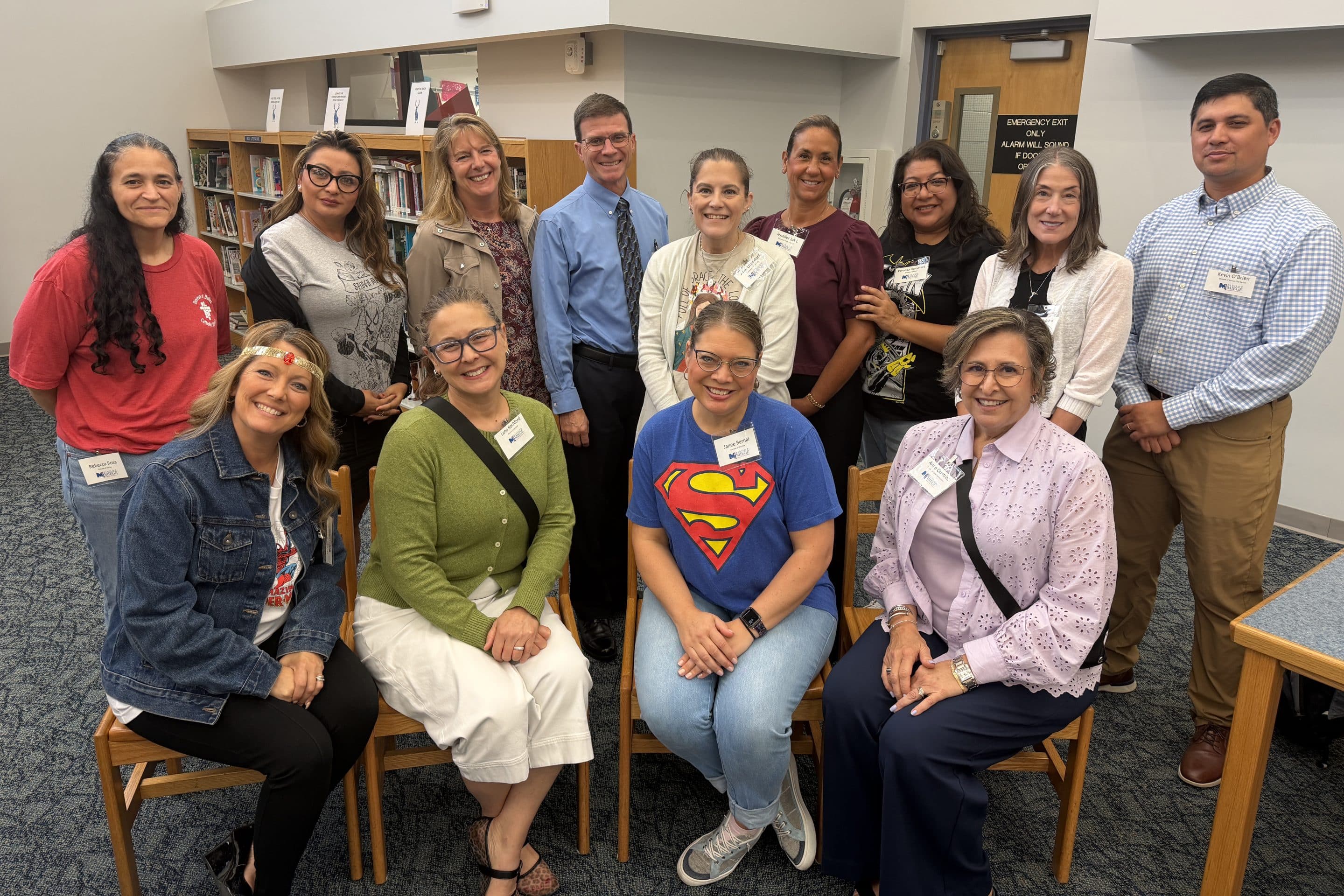
The ACE Principal Academy Fellows brought experience from Catholic schools across the country to Bishop Miege. As part of a two-year professional formation experience for Catholic school principals, the Fellows visited Miege to learn from our community and share in the practices that help Catholic schools thrive.
Relationships shape our Catholic school community
Students may experience Catholic school culture every day, but it is the people throughout the building who help create it.
Mallorie Hurlbert, Learning Resource Director, put it simply: “I know we say community over and over and over again, and sometimes it gets repetitive, but it is truly what makes this building and place so special.”
For Scott Anderson, Physics teacher and robotics coach, those relationships are also part of what allows Miege to live out its motto, Nova Et Vetera, meaning “the new and the old.”
“I think we really embrace our motto, which not all schools can say,” he said. “There’s a lot of tradition involved. One of the things that I’m really proud of as a school is that we are able to pivot when something comes up because we have these relationships already.”
That ability to respond and move forward is part of what makes Catholic school culture come to life when a school community is built on trust.
Jane Barreca, Math Hub Director, described the importance of making sure people feel seen for who they are, not simply for the role they hold.
“The biggest thing as a staff member and as a student is that you’re a person before you’re a student or before you’re just an employee here,” she said. “Everybody does a really good job of treating you that way and making sure if something’s going on with your family, they’re there and they understand. The pressures of our roles aren’t always at the forefront of what’s most important. We are taking care of each other and ourselves.”
That care extends beyond the school day and beyond graduation.
Jon Holmes, Alumni Director and football coach, reflected on the teachers, administrators, and coaches who invested in him when he was a student at Miege. Today, he tries to create those same relationships for current students.
“Our faculty and staff for a long time have gone out of their way for others, so that’s one thing I strive to do every single day when I’m here to make sure that our next generation of students feel the same,” he said. “If it helps one or two of these students after their time here and helps them find their career path or helps them get a better understanding of what they want to do post-graduation, then at the end of the day, we’re doing our job.”
At Miege, formation happens through people. A teacher, coach, counselor, administrator, or classmate can make a difference simply by taking the time to know a student.
A student panel gave our guests a firsthand look at the school culture they experience every day. They shared their perspectives on what makes the Miege community unique, from the relationships they build across grade levels to the many paths they discover along the way.
Catholic school culture in action
The ACE Principal Academy visit gave our students and faculty the chance to talk about the things that can be difficult to capture in a brochure or a tour.
They talked about relationships.
They talked about student voice.
They talked about finding your own path.
They talked about being known as a person before being known as a student or employee.
And they talked about showing up for one another.
Those are the everyday moments where mission becomes visible.
They are also the moments that remind us that a Catholic school community is shaped not only by what we teach, but by how we live together. At Bishop Miege, Catholic school culture isn’t something that exists only in a mission statement.
We were grateful to welcome the Cabrini Fellows to Bishop Miege and to share a glimpse of the people, traditions, and relationships that make this community what it is.
This is mission in action.